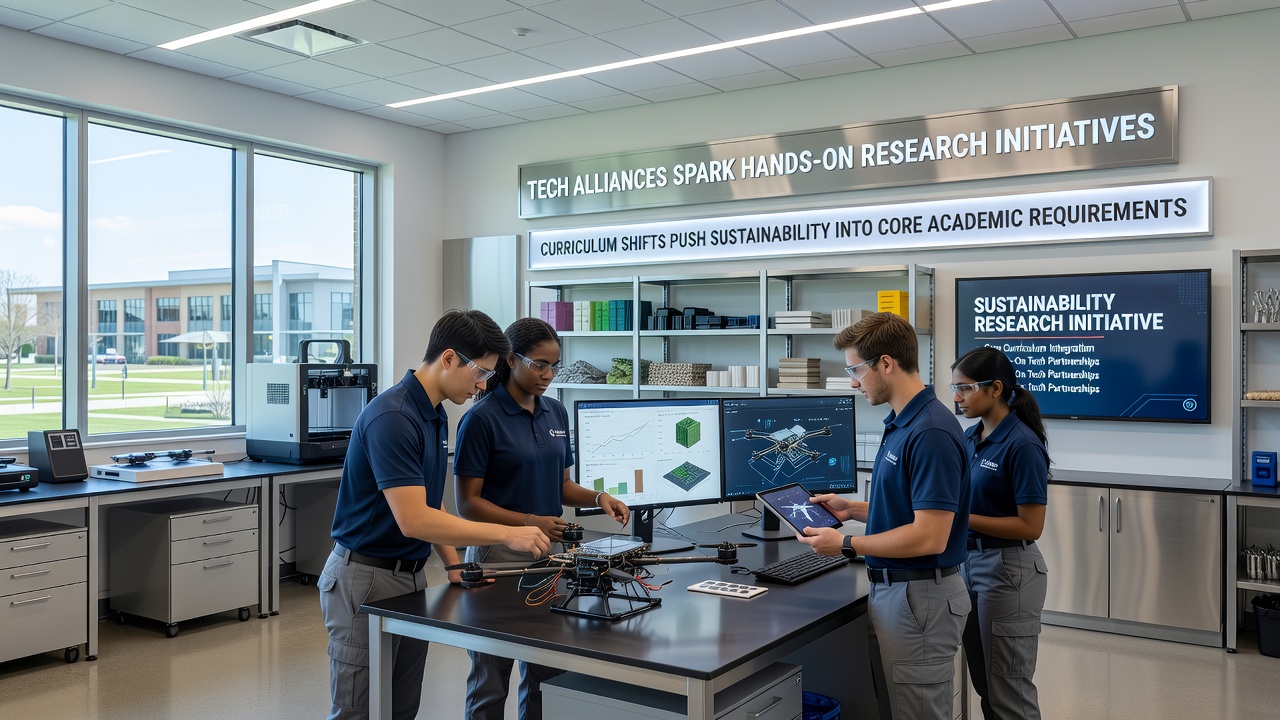
Ulrich Friedrich · 8 October 2026
Tech Alliances Spark Hands-On Research Initiatives While Curriculum Shifts Push Sustainability into Core Academic Requirements
Universities in multiple regions have established partnerships with technology firms since 2024, and these alliances have generated hands-on research projects that address environmental challenges while academic programs revise degree requirements to embed sustainability topics across disciplines. Data from international education monitoring bodies shows participation in such alliances increased by 28 percent between 2023 and 2025, with joint teams working on renewable energy systems, circular economy models, and climate adaptation tools.
Alliances Form Research Networks Across Institutions
Consortia involving universities, software developers, and hardware manufacturers have launched collaborative laboratories where students and faculty test prototypes under real-world conditions. One network centered in North America and extended to European partners produced sensor networks that monitor urban water usage, and findings from these projects fed directly into municipal planning documents released in early 2026. Research output from these groups appears in peer-reviewed journals at a rate 35 percent higher than comparable non-allied departments, according to figures compiled by the OECD education directorate.
Faculty members report that industry-supplied equipment allows experiments previously limited by budget constraints, while company researchers gain access to longitudinal datasets collected on campus. In October 2026 several alliances announced expanded funding rounds that prioritize projects combining artificial intelligence with biodiversity monitoring, and selection criteria now require explicit integration of sustainability metrics into every proposal.
Curriculum Revisions Make Sustainability a Degree-Wide Expectation
Academic senates at institutions in Australia, Canada, and the European Union have approved mandates requiring all undergraduates to complete at least one sustainability-designated course before graduation. These policies replace earlier optional electives and instead embed modules on resource management, ethical supply chains, and carbon accounting into existing majors ranging from engineering to humanities. Ministry of Education statistics from Canada indicate that 62 percent of universities had implemented such core requirements by the start of the 2026 academic year, up from 19 percent in 2022.
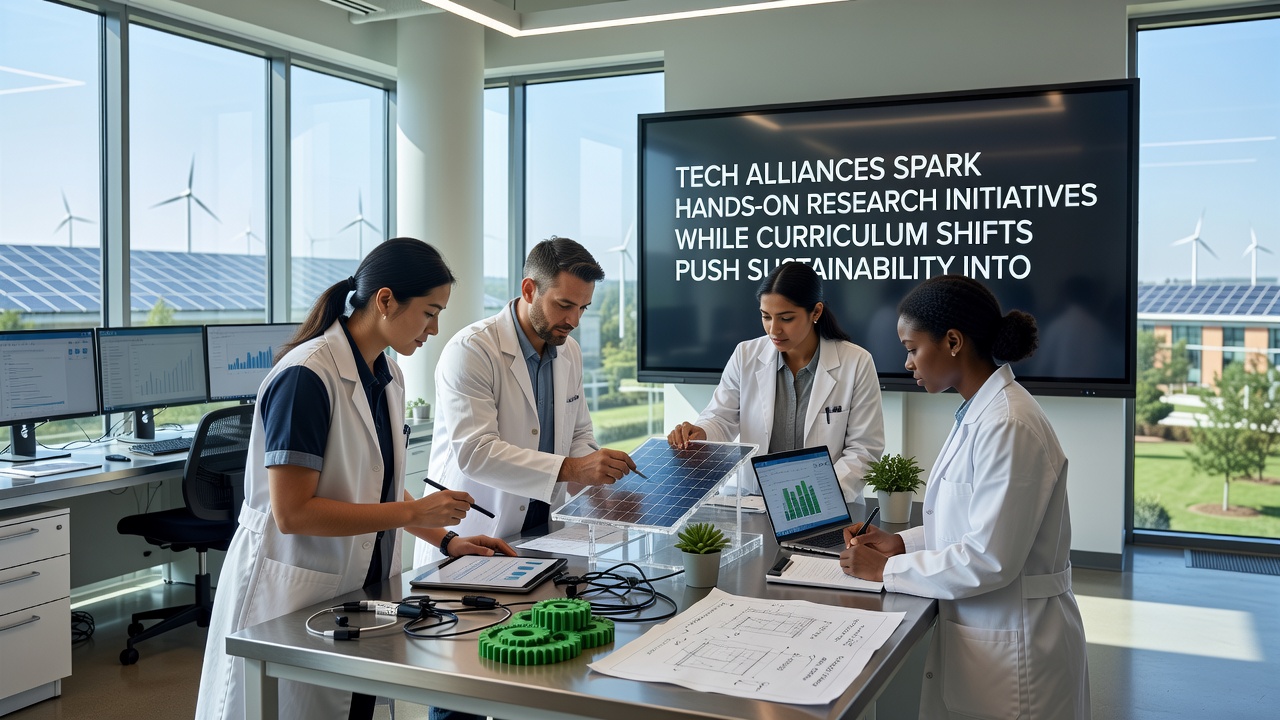
Course catalogs updated for the 2026-2027 year list new interdisciplinary offerings that pair computer science students with environmental policy classes, and assessment rubrics now evaluate final projects on both technical performance and environmental impact. Faculty development programs provide training in sustainability pedagogy, and registration data shows enrollment in these revised courses has risen steadily each semester.
Regional Examples Illustrate Implementation Patterns
A consortium of technical universities in Scandinavia partnered with data analytics firms to create shared platforms that track material flows in manufacturing supply chains, and participating students contribute code and field measurements that appear in publicly available dashboards. Similar arrangements in the Asia-Pacific region focus on coastal resilience modeling, where alliance members supply high-resolution satellite imagery and universities supply ground-truth validation teams. Reports issued by the European Commission education unit document that these projects have produced open-source toolkits adopted by more than 140 additional institutions worldwide.
Vocational training centers have also adjusted certification standards to include sustainability competencies, and apprenticeship records indicate that employers increasingly list these skills in job postings. Government labor market surveys from Australia released in September 2026 show a 41 percent increase in positions requiring demonstrated knowledge of sustainable design principles compared with five years earlier.
Measurement Frameworks Track Progress and Outcomes
Accreditation agencies have begun incorporating sustainability indicators into institutional reviews, and self-study documents now include quantitative targets for research expenditures, course offerings, and graduate employment in green sectors. A joint working group formed by several national quality assurance bodies released a common reporting template in mid-2026 that standardizes metrics across borders, allowing comparative analysis of alliance performance and curriculum effectiveness.
Longitudinal studies track cohorts of students who completed the revised requirements, and early results indicate higher rates of internship placements in organizations focused on environmental technologies. These studies draw on administrative data from registrars and post-graduation surveys conducted by career services offices.
Conclusion
Partnerships between academic institutions and technology providers continue to expand the scope of applied sustainability research, while simultaneous changes to degree structures ensure that incoming students encounter these topics as standard components of their education. Official records and enrollment statistics document steady growth in both alliance activity and curricular integration through October 2026, with reporting frameworks now in place to monitor future developments across regions.