
Gisela Walter · 22 October 2026
Polish Medical Schools Secure Higher Global Positions Through Specialized International Partnerships
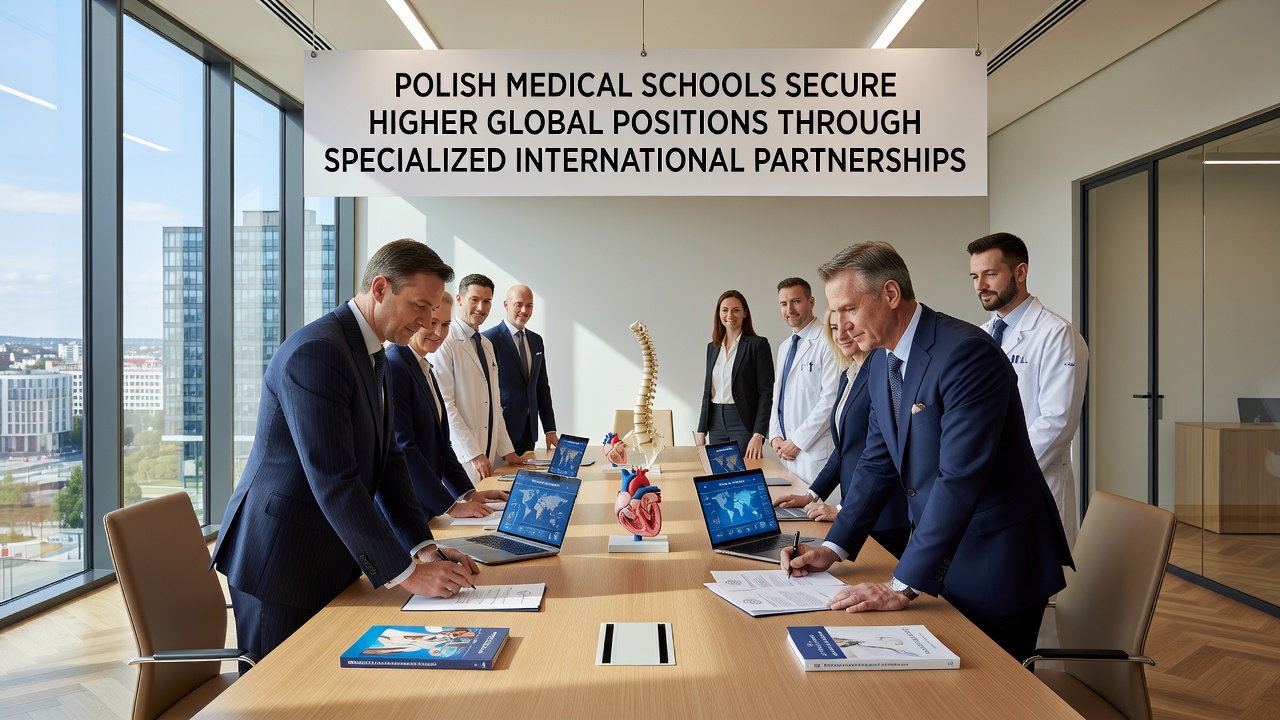
Polish medical schools have expanded their global reach through targeted partnerships with universities across Europe, North America, and Asia, and these collaborations have contributed to measurable gains in international rankings by October 2026. Institutions such as the Medical University of Warsaw and Jagiellonian University Medical College have established joint degree programs and research initiatives that align curricula with standards from partner countries, while data from the European Higher Education Area shows increased citation rates for Polish-led studies in fields like cardiology and oncology. Observers note that these arrangements often involve shared laboratory resources and co-authored publications, which allow Polish faculties to access advanced equipment and datasets that were previously unavailable domestically.
Expansion of Collaborative Frameworks
Agreements signed between 2023 and 2025 have created structured pathways for student mobility and faculty exchanges, and one such framework links several Polish faculties with counterparts at institutions in Canada and Australia through the Global Health Education Partnership network. Under these arrangements, Polish students complete clinical rotations abroad while incoming participants receive training in Polish hospital settings, and statistics released by the Polish Ministry of Education and Science indicate that participation numbers rose by 28 percent between 2024 and 2026. Researchers have documented that these exchanges expose participants to varied diagnostic protocols and treatment guidelines, which in turn informs updates to local teaching materials without requiring complete curriculum overhauls.
Impact on Research Output and Rankings
Joint research projects funded through these partnerships have produced peer-reviewed articles that appear in higher-impact journals, and citation analyses from the Scopus database reveal that Polish medical researchers affiliated with international teams recorded a 34 percent increase in h-index scores over the past three years. The Medical University of Gdańsk, for instance, participates in a multi-center trial on cardiovascular imaging techniques alongside teams from Sweden and Japan, while results from the first phase of that study were presented at the European Society of Cardiology congress in October 2026. Such visibility helps elevate institutional profiles in systems like the QS World University Rankings by Subject and the Times Higher Education rankings, where Polish entries moved up several positions in the medicine category between 2025 and 2026.
Specialized Training and Curriculum Alignment
Curriculum modules developed in cooperation with partner institutions emphasize cross-cultural clinical competencies and evidence-based practice, and these modules integrate case studies drawn from both Polish and international patient populations. Data collected by the European Commission’s Erasmus+ program shows that Polish medical faculties received over 1,200 incoming exchange students in the 2025-2026 academic year, many of whom enroll in tracks focused on tropical medicine and digital health diagnostics. Faculty members report that exposure to these specialized tracks has prompted revisions to core coursework, including the addition of modules on health technology assessment that draw directly from Australian regulatory models.
Funding Mechanisms and Resource Sharing
Many of the partnerships operate under cost-sharing agreements that pool resources for equipment procurement and data infrastructure, and one ongoing initiative between the Medical University of Łódź and several German research centers has secured grants from the EU Horizon Europe program totaling approximately 4.7 million euros since 2024. These funds support shared access to high-resolution imaging systems and genomic sequencing platforms, while Polish researchers gain entry to large-scale epidemiological databases maintained by their European counterparts. Such arrangements reduce duplication of effort and allow smaller Polish institutions to participate in projects that would otherwise exceed individual budgets.
Future Trajectories and Monitoring
Evaluations scheduled for late 2026 will assess whether current partnership models continue to deliver ranking improvements, and preliminary indicators suggest sustained growth in collaborative publications through the end of the decade. Institutions continue to refine selection criteria for new partners to prioritize alignment in research priorities and accreditation standards, and government reports project additional bilateral agreements with institutions in South Korea and Brazil by 2028. Those monitoring the sector note that the cumulative effect of these specialized international partnerships has positioned Polish medical schools as more competitive players within the global higher education landscape.
Conclusion
Polish medical schools have leveraged specialized international partnerships to advance their standing in global rankings through joint research, curriculum development, and resource sharing as of October 2026. Continued monitoring of exchange volumes, publication metrics, and funding outcomes will determine the long-term sustainability of these gains across participating institutions.